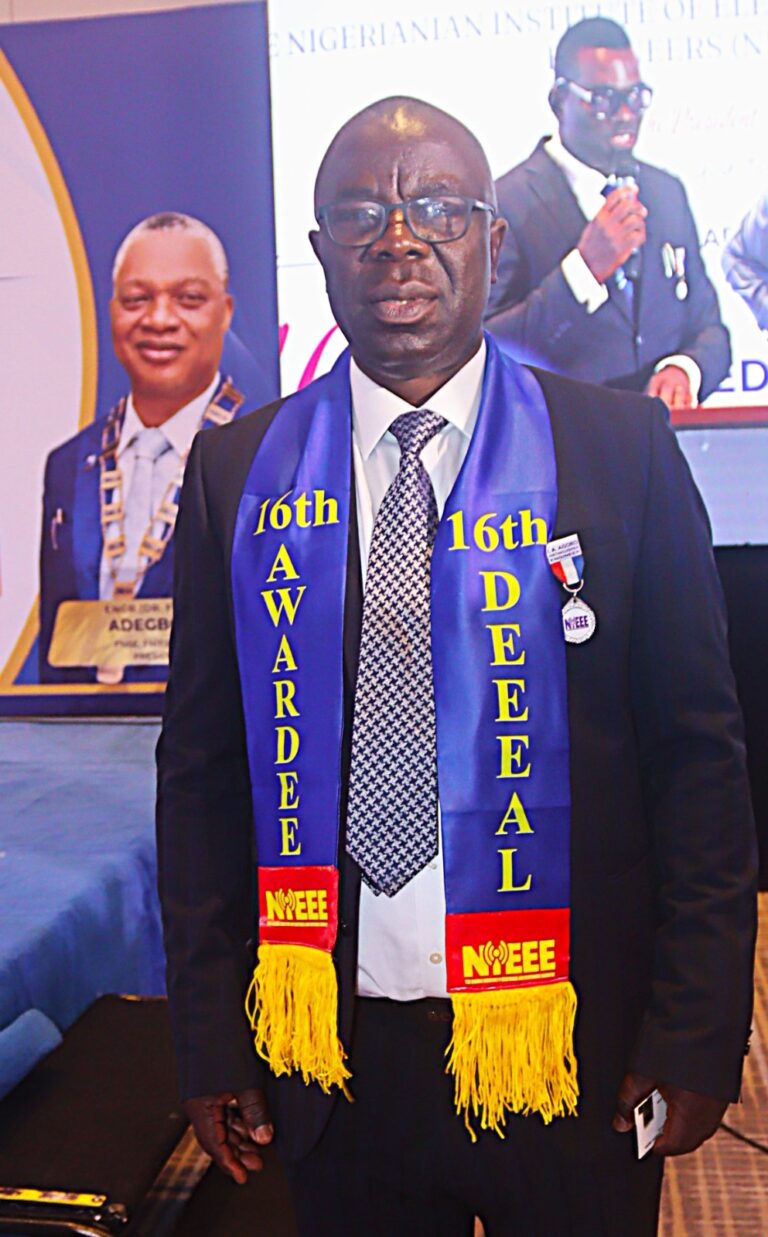
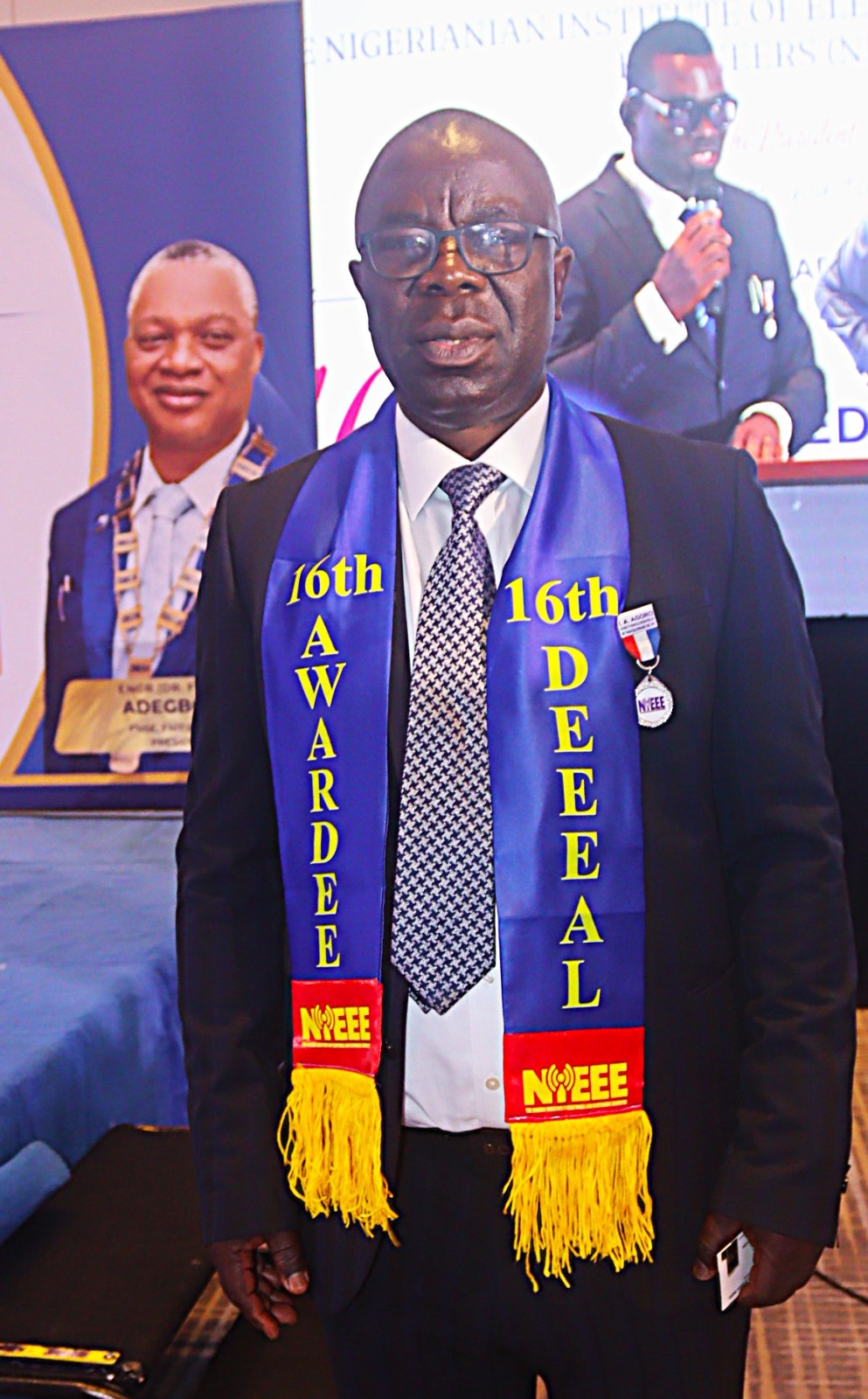
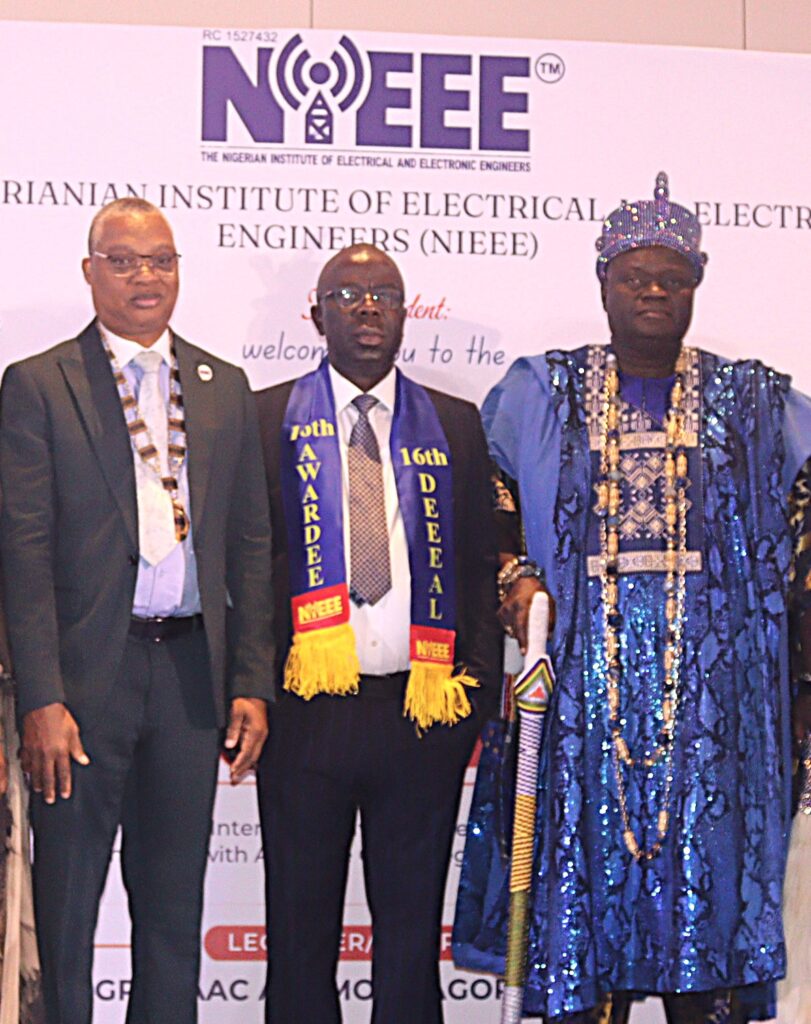
The Nigeria Institute of Electrical and Electronic Engineers (NIEEE), recently in Lagos honoured one of their own in the person of Engr. Isaac Ademola Agoro, FNSE, FNIEEE, as the 16th Distinguished Electrical and Electronic Engineering Award Laureate (DEEEAL) and lecturer.
This unique award platform was inaugurated in the year 2000, and according to NIEEE President Engr. Dr. Felix Adesola Adegboye, FNSE, FNIEEE, the “DEEEAL award stands as the crown jewel of our institute’s intellectual and professional attainment. Since inception, this platform has served a singular, vital purpose to bring together the finest minds in our profession to proffer concrete, engineering-backed solutions to the infrastructure and technological challenges of our nation.”
The platform over the years has been used to recognize some prominent engineers who have distinguished themselves in the field of electrical and electronic engineering and those that have received the recognition include professionals like Engr. Prof. Cladius Ojo Aremu Awosope, FNSE; Engr. Dr. Olusegun Ajayi, FNSE; Engr. Ibikunle S. Ogunbayo, FNSE; Engr. Titi Omo-Ettu, FNSE; and Engr. Ifeoluwa Oyedele, FNSE, FNIEEE just to mention but few.
This year’s edition was the 16th in the series with the lecture topic: “Optimized Design and Interconnectivity Strategy for Distributed Generation in Multi-Community Mini grids with Adaptive Grid Integration Pathways in Sub-Saharan Africa.”
According to the President who described the lecture topic as being ‘prophetic and profoundly necessary’ stated that “for too long, Sub-Saharan Africa has approached rural and sub-urban electrification through isolated, fragmented mini grids. While they provide immediate relief, stand alone minigrids often lack economic resilience and technical capacity to handle growing industrial loads.”
“To be a DEEEAL lecturer is an honour reserved strictly for those who have demonstrated peerless technical expertise, unwavering ethical standards, and a lifetime of impactful contribution to electrical and electronic engineering practice.”
Engr. Isaac Ademola Agoro, FNSE, FNIEEE selections is as a result of his overwhelming and deep research and practical execution in the field of distributed energy resources and by this honour NIEEE validates his work as a reference standard for the next generation of African engineers.
Other notable dignitaries at the event include honourable minister of power Chief Joseph O. Tegbe, who was represented by Dr. Owolabi Sunday; the President of NSE, ably represented by Engr. Dr. Bola Mudasiru, FNSE, FNICE; Engr. Ajanaku, FNSE, FNICE, National Chairman of NICE & General Manager of Lagos State Public Works; the Royal Father of The Day Oba of Erin-Ire in Osun state.
Other personalities present at the event are past presidents of NIEEE, past recipients of the award and fellows of the institute.
The lecturer/awardee Engr. Agoro took time to explain the difference between Minigrids and Microgrids; the Architecture of Mini Grids; Grid Designs etc. He also spoke on the high cost of the centralized Grid systems in operation in Nigeria. The needs “to decentralize the national grid which over the years the national power systems have relied on the centralized model: large-scale power plants (hydro, gas, coal)transmitting power over hundreds kilometers of High-Voltage (HV) transmission lines down to Medium-Voltage (MV) and Low-Voltage (LV) distribution networks.”
In comparison of mini grids and microgrids, Engr. Agoro stated that “the terms ‘minigrid’ and ‘microgrid’ are frequently used interchangeably, but they have distinct connotations depending on context and geography. Both are localized systems that combine generation, storage, and distribution within a defined boundary and that can operate in an isolated mode, disconnected from a larger grid.”
According to him “a minigrid, by contrast, is the term more commonly used to describe a village or community-scale network that may never have been connected to a national grid and that often constitutes the primary or sole source of electricity for its customers. In some countries, regulation classifies systems below 10kw as microgrids while renewable-based distribution systems of 10kw and above typically 10-200 kw are classified as mini grids.”
Engr. Agoro defined minigrid as an independent community or multi community-scale power systems incorporating distributed generation, storage, and a local distribution network, capable of serving residential, commercial, and productive-use loads either in isolation or where applicable, interconnected with the central grid.
“Some of the suggestions made by Engr. Agoro to fully power African countries is to encourage adoption of interconnected mini grids, and to actualize that there must be a rapid transition from isolated microgrids to interconnected mini grids and there must be willingness to adopt the following strategies: harmonization of national interconnection and grid codes; legislation of clear grid-arrival and transition regulations across more countries; establishment of transparent, cost-reflective Disco and tariff frameworks; mobilization of blended and concessional finance at scale; finance productive use of energy; building DisCo and regulator institutional capacity; investment in geospatial least-cost planning and promotion of regional knowledge-sharing.
The honorable minister of power, ably represented by Dr. Owolabi Sunday Director, Renewable and Rural Access of The Federal Ministry of Power, while delivering the mister’s goodwill message congratulates Engr. Agoro for the award “I congratulate Engr. Agoro whose remarkable contributions to electrical engineering and national development have earned him this prestigious recognition. Your career exemplifies professionalism, innovation, integrity and services” He encourage other engineers most especially NIEEE members to emulate Engr. Agoro’s landmark contributions to the national growth trajectory.
In his response to the recognition Engr. Agoro spoke with CED Magazine and expressed his joy for being recognized by NIEEE and promised to keep contributing to the growth of the institute’s vision, most especially in the area of mentoring and development of the younger and upcoming engineers in Nigeria.
SOURCE: IN HOUSE
About The Author