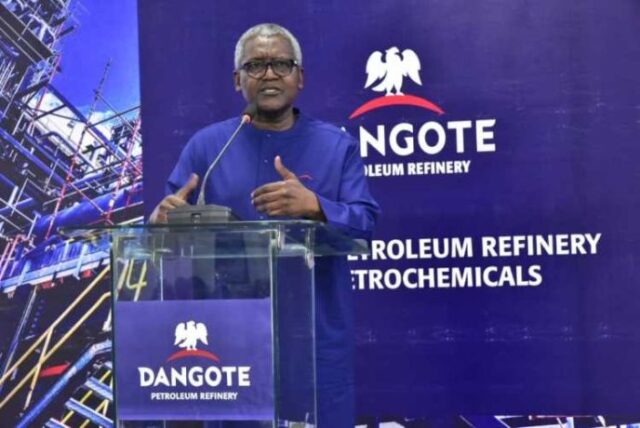
The Dangote Petroleum Refinery and Petrochemicals FZE has accused the Federal Government and its agencies of alleged deliberate sabotage, undermining its operations and frustrating its investment in Nigeria’s downstream petroleum sector, an allegation the FG denied.
In a recent affidavit filed before the Federal High Court in Lagos seeking an interim injunction to stop the issuance and renewal of petroleum import licences, the company said its operations are anchored on crude oil supply arrangements with the Nigerian National Petroleum Company Limited, which it described as central to its refining business.
But the NNPC refuted the claims, stressing that it would raise a preliminary objection challenging the competence of the suit and the refinery’s locus standi
According to a copy of the affidavit obtained by The PUNCH, the refinery told the court that, pursuant to its status as the operator of a domestic refinery in Nigeria, its business operations include purchasing crude oil from the Federal Government of Nigeria through the NNPC and refining the products for sale to Nigerians to ease pressure on the government to make petroleum products available for local consumption.
The refinery, however, alleged that the government had failed in its obligation to ensure adequate crude supply to local refineries, claiming the development was deliberate and harmful to its investment.
“However, contrary to the government’s obligation to ensure the adequate supply of crude oil to local refineries such as that of the applicant, the government, through the NNPC, has deliberately neglected to do so, in a bid to sabotage the applicant’s investment in the oil and gas industry in Nigeria,” the refinery alleged.
According to the company, the shortfall in crude allocation has forced it to consistently source a substantial portion of its crude feedstock through international traders, who charge additional premiums on top of already elevated spot market prices.
The refinery further disclosed that its current allocation from NNPC falls far below operational requirements, saying it currently receives just five crude oil cargoes per month from the NNPC, “which is less than half of the 13 cargoes” required to maintain full supply of petroleum products.
On regulatory matters, the company alleged that despite producing above domestic demand, the Nigerian Midstream and Downstream Petroleum Regulatory Authority has continued to issue and renew import licences in breach of the Petroleum Industry Act.
“In spite of full production by the applicant’s refinery, the reported production of the applicant’s refinery as published by the NMDPRA (both of which exceed national consumption) and the provision of Section 317(9) of the PIA… the NMDPRA has threatened and proceeded to issue import licences to other companies and petroleum marketers in violation of the provisions of the PIA,” it stated.
The refinery listed some of the companies allegedly benefiting from the import regime, including A.A. Rano Limited, Matrix Petroleum Services Limited and AYM Shafa Limited.
It further argued that import licences are issued quarterly, “and the applicant is apprehensive that the NMDPRA will continue to issue or renew import licences to these other companies”.
The company also accused government agencies of creating an unfavourable operating environment for its refinery, stating, “The government’s deliberate acts of sabotage through the NMDPRA, NUPRC and the NNPC create a negative environment for the applicant’s investment in the Nigerian oil and gas industry.”
Despite its grievances, the refinery told the court it had made attempts to engage relevant authorities in line with the objectives of the Petroleum Industry Act through a letter dated June 14, 2024, routinely appealing to the government agencies for the implementation and execution of the objectives of the PIA.
On its investment, the company said it committed massive capital with the expectation of regulatory support and policy stability under the Petroleum Industry Act.
It warned that the alleged actions of government agencies could have severe consequences for its operations and the wider economy. “The defendant’s violation of the provisions of the PIA through the NMDPRA, NUPRC and the NNPC portends grave consequences for the applicant’s investment in the oil and gas sector.”
It also stressed its role in employment and national development, warning of broader socio-economic risks if its operations are disrupted. The company argued that it faces irreparable harm if the court does not grant its request.
“The applicant is one of the largest employers of labour in the formal sector of the country after the government and the largest private employer in the country. Should the applicant’s investment in the refinery fail, it would lead to mass loss of employment for Nigerian citizens.
“If the defendant is not restrained from issuing or continuing with the issuance and/or renewal of import licences to persons/companies (through the agencies under its supervision, such as the NMDPRA) without complying with the provisions of the PIA, the applicant’s investment will be in severe jeopardy of failing, and it would be impossible to compensate this loss in damages.
“The balance of convenience is in favour of the applicant, as it will suffer irreparable damage if this application is not granted,” Dangote argued.
The company filed an ex parte motion on notice under Suit No: FHC/L/CS/2026, seeking urgent interim injunctions against the Attorney General of the Federation and the government agencies.
Responding, however, the NNPC said it would raise a preliminary objection challenging the competence of the suit and the refinery’s locus standi. “The plaintiff’s suit is premature; the plaintiff lacks locus standi,” the affidavit said.
The state oil company declared that Dangote refinery’s petroleum products were already expensive and subject to price swings dictated by commercial interests. “The plaintiff’s petroleum products are already sold at significantly high and fluctuating market prices, dictated by its commercial interests,” the company said.
NNPC specifically defended the roles of the NUPRC and NMDPRA in the dispute, saying, “The 2nd defendant, NMDPRA, NUPRC and other relevant agencies of government have not frustrated the plaintiff in the execution of its business objectives or refinery operations in any manner whatsoever.”
NNPC also denied allegations of sabotage and deliberate denial of crude oil supply to the refinery. “The government and the 2nd defendant have not deliberately denied the plaintiff a crude oil supply,” the company stated.
It added, “Contrary to the plaintiff’s allegations, the 2nd defendant has not sabotaged the plaintiff’s refinery operations.”
SOURCE: PUNCH NEWS PAPER
About The Author