
The Petroleum and Natural Gas Senior Staff Association of Nigeria (PENGASSAN) has said it is reviewing key details in the Memorandum of Understanding (MoU) between the Nigerian National Petroleum Company (NNPC) and two Chinese firms before issuing an official stance.
PENGASSAN’s General Secretary, Comrade Jerry Amah, disclosed that the union was taking time to thoroughly study the agreement. He stated that the association would prepare and release its position after completing the assessment. “We are preparing our position after studying the contractual obligations,” Amah said.
The review comes amid ongoing discussions about NNPC’s MoU with Chinese companies, which relates to refinery operations, though the union’s statement did not specify any details of the deal.
In contrast, the Nigeria Union of Petroleum and Natural Gas Workers (NUPENG) has chosen not to comment on the matter at this time. NUPENG’s General Secretary, Comrade Afolabi Olawale, explained that he was unavailable because he was on leave out of the country. “Please, I’m on leave and currently out of the country,” Olawale told LEADERSHIP.
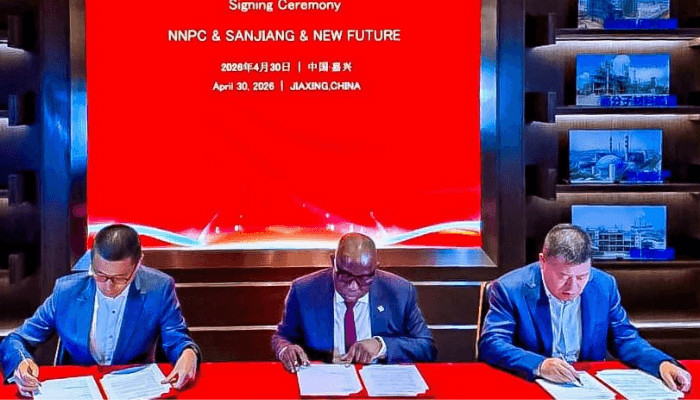
Recall that the Nigerian National Petroleum Company Limited (NNPC), on Monday, said it signed a Memorandum of Understanding (MoU) with Sanjiang Chemical Company Limited and Xingcheng (Fuzhou) Industrial Park Operation and Management Co. Ltd for a potential Technical Equity Partnership to complete, operate, and upgrade the Port Harcourt and Warri Refineries.
The agreement was signed by NNPC, Group CEO Bashir Bayo Ojulari and the Chinese firms’ chairmen to boost sustainable performance, expand petrochemical capacities, and develop gas-based industrial hubs.
The NNPC said the potential framework would cover the completion of outstanding work at the two refineries, as well as the operating and maintenance of both facilities to achieve best-in-class, sustainable performance.
“Planned expansion and upgrades would elevate both facilities to cleaner, more profitable product standards. The potential collaboration also contemplates expanding the refineries’ petrochemical capacities and harnessing gas and downstream opportunities through the development of co-located, gas-based industrial hubs,” the company stated.
Ojulari, described the MoU execution as a significant milestone, following more than six months of concerted engagement between the technical and management teams of NNPC and the two Chinese partners, Sanjiang and Xinganchen.
“All parties recognise mutually beneficial opportunities for the development and long-term sustainable profitability of NNPC’s refining assets in Nigeria, and the collective weight required for success,” Ojulari noted.
The GCEO further stated that the MoU is an important step on the journey towards identifying potential technical equity partner(s) to restart and expand NNPC’s refineries, and to explore opportunities in co-located petrochemicals and gas-based industries.
The MoU reflects the parties’ shared intent to progress discussions in good faith, with any definitive arrangements to follow in due course and subject to customary approvals.
However, the publicity secretary of the Crude Oil Refinery Owners Association of Nigeria (CORAN), Eche Idoko, said it is strange to begin the rehabilitation of refineries that have not worked for years in China without verifiable technical knowledge of refinery operations in the region.
Idoko, said that it had been the expectations of industry leaders that government could extract expertise from successful local refineries to execute the project and in that case save the country the seeming capital flight.
He feared that alleged political interference that has stalled the resuscitation of the refineries could be part of what led to the choice of Chines firms to run the business.
“Well let me say the Chinese may know what we don’t know and could get it right this time but local partnership is still a good idea because we have about five functional refineries running today in the country. We know that the Chinese could have been involved in the operations of some modular refineries but their full technical expertise in such sophisticated technology is the concern at this point” he added.
SOURCE: LEADERSHIP NEWS PAPER
About The Author