
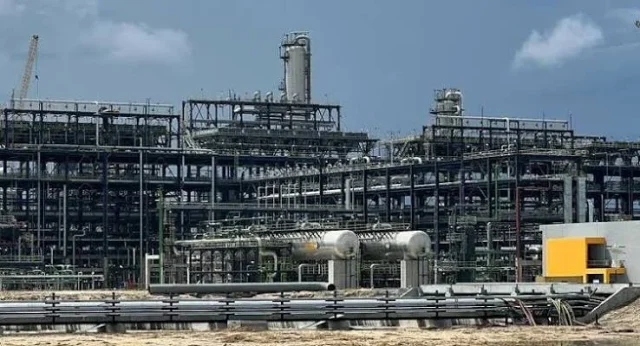
The regulator of the midstream and downstream petroleum sector has told The PUNCH exclusively that the Dangote Petroleum Refinery has not violated any provision of the Petroleum Industry Act by opting to sell fuel in dollars instead of naira.
Multiple senior sources within the regulatory agency, who spoke on condition of anonymity, said the refinery has the right to recover its costs if it has been purchasing crude oil in dollars.
According to the officials, the Petroleum Industry Act allows operators to earn returns on their investments and recover eligible costs.
“It’s a pretty straightforward issue. The naira-for-crude deal is not to Dangote’s advantage right now. They are sourcing a lot offshore. And with the crisis in the Middle East, the refinery has to recover costs now. It has to survive.
“Basically, to be fair to Alhaji Aliko Dangote, he has tried, if you look at it. He has absorbed a lot. But maybe he has reached a breaking point. So he has to do stuff to recover costs. And that’s why he wants to share that burden with off-takers,” one source said.
Another official told our correspondent that the PIA permits operators that incur costs in dollars to recover those costs in the same currency.
“If you study the PIA relevant schedules and provisions, when it comes to tariffs, you can recover your costs in dollars if that’s what you’ve spent. So, it’s clear. That is the case. There’s nothing wrong with what the Dangote refinery has done. That’s why you’ve not heard any hoopla, even from major off-takers. Dangote is incurring costs in dollars. So what do you want him to do?” the official said.
“Basically, to be fair to Alhaji Aliko Dangote, he has tried, if you look at it. He has absorbed a lot. But maybe he has reached a breaking point. So he has to do stuff to recover costs. And that’s why he wants to share that burden with off-takers,” one source said.
Another official told our correspondent that the PIA permits operators that incur costs in dollars to recover those costs in the same currency.
“If you study the PIA relevant schedules and provisions, when it comes to tariffs, you can recover your costs in dollars if that’s what you’ve spent. So, it’s clear. That is the case. There’s nothing wrong with what the Dangote refinery has done. That’s why you’ve not heard any hoopla, even from major off-takers. Dangote is incurring costs in dollars. So what do you want him to do?” the official said.
Another source urged authorities in the upstream sector, including the Nigerian National Petroleum Company Limited, to address the challenges affecting the naira-for-crude arrangement.
“We have identified the gaps from the refinery, and it is for crude suppliers to do the needful supply. It is between the refinery and the dominant crude market supplier, which is the NNPC. Why are they not supplying the refinery? Why does it have to do the dominant purchase offshore? That’s why he has to recover his cost in dollars. It’s simple. The PIA doesn’t have an issue with that. It’s tariffing,” the source stated.
On Monday, the Dangote refinery announced that it would begin quoting ex-depot prices for petrol, diesel and aviation fuel in dollars for gantry and coastal transactions.
In a message to marketers on Monday, the company said, “Following our email on the 9th of July, 2026, regarding the transition from Naira to United States Dollars, please note that all issued Naira Coastal and Gantry PFIs/Deal Recaps are now invalid, and no payments should be made against them.”
Under the new pricing schedule, petrol sold through the gantry will cost $0.779 per litre, diesel $1.087 per litre, and aviation fuel $0.942 per litre, while coastal PMS supplies will sell for $1,044.62 per metric tonne.
The company, however, clarified that the new pricing arrangement does not apply to liquefied petroleum gas. Following the announcement, depot owners across major petroleum hubs began adjusting their loading prices as marketers factored in possible changes in replacement costs.
Pricing data from petroleumprice.ng showed that petrol prices increased by as much as N113 per litre at some depots, while diesel prices rose by up to N150 per litre in some locations.
Petroleum products marketers rejected the decision, arguing that they could not source scarce dollars to buy products that would ultimately be sold to Nigerians in naira.
Defending the decision, senior management sources at the Dangote Group told The PUNCH that the company had accumulated a large volume of requests for dollars from crude suppliers within and outside Nigeria because the refinery was not receiving sufficient crude from the NNPC under the naira-for-crude arrangement.
The sources added that the renewed tensions in the Middle East, which pushed oil prices to about $80 per barrel, had increased the refinery’s need for dollars to import crude and purchase supplies from local private producers.
According to the sources, the refinery has faced significant challenges selling fuel in naira while buying crude in dollars, adding that companies operating in free zones are permitted to sell their products in foreign currency.
The company said it had incurred substantial losses while waiting for dollar allocations and could no longer absorb the cost.
“Do you know how much we have lost waiting for the allocation of dollars? We can’t be subsidising the country after the government has withdrawn the subsidy. We are in a free zone, and that’s how it’s normally done. When we sell in naira, we are not being given dollars.
“We have a huge accumulation of requests for dollars piling up, and we are being given very little crude against the naira. It is not our fault. We are buying products in dollars. It is the other party that has failed to uphold the crude-for-naira agreement,” the sources said.
Independent petroleum marketers and energy experts opposed the dollar-denominated pricing of petroleum products, warning that the move could intensify foreign exchange pressures and create fresh instability in the downstream petroleum sector.
The stakeholders, who spoke separately with The PUNCH on Tuesday, argued that although the refinery, as a private business, has the right to make commercial decisions, pricing petroleum products consumed locally in dollars could have broader implications for the economy.
The Petroleum Products Retail Outlets Owners Association of Nigeria also criticised the development, saying dollar-denominated fuel transactions could gradually push the country towards a dollarised economy and undermine efforts to stabilise the downstream petroleum market.
About The Author