

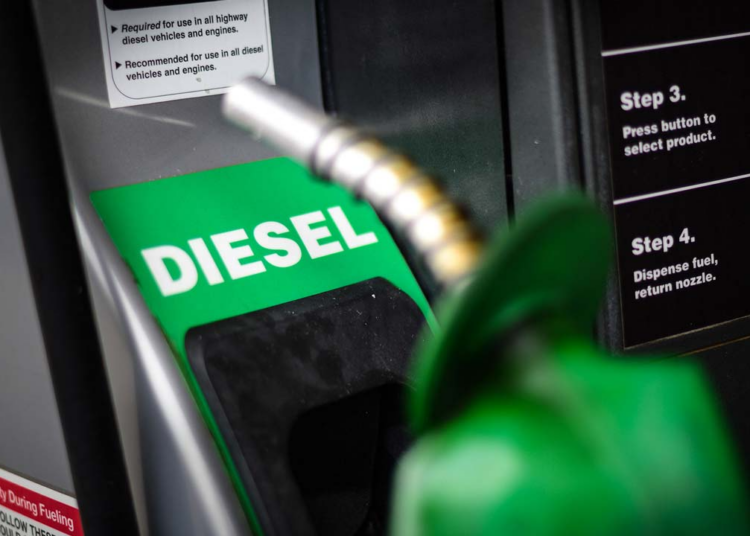
Nigeria’s industrial clusters are under mounting pressure as manufacturers switch from diesel to gas for cost savings and reliability, only to face fresh shocks from the Nigerian Midstream and Downstream Petroleum Regulatory Authority’s (NMDPRA) recent hike of wholesale gas prices—from $2.13/MMBtu to $2.18/MMBtu effective April 1—compounded by dollar-linked pricing that amplifies forex volatility in an already strained energy market.
Diesel costs have surged past N1,600 per litre due to the Iran-Israel war’s global ripple effects, accelerating the pivot in hubs like Ogun’s Sango-Ota and Sagamu, Kano’s Sharada, Lagos’ Apapa, and Rivers’ Trans-Amadi.
Yet, this NMDPRA adjustment on the Domestic Base Price (DBP)—with commercial users now at $2.68/MMBtu up from $2.63—threatens to erode the 50-60 per cent operational savings that lured firms to gas in the first place.
As Nigeria’s manufacturers race to replace diesel with cheaper gas amid soaring fuel costs and power shortages, dollar-linked pricing is emerging as a major squeeze on their operations, exposing firms to forex volatility even as they chase long-term savings.
The shift is most pronounced in Ogun State’s industrial hubs—Sango-Ota, Sagamu, Agbara, Interchange, and Ogere—where factories are investing heavily in gas generators and embedded plants. But the trend extends nationwide, with clusters in Kano, Lagos, Rivers, Anambra, and beyond following suit, according to data from the Manufacturers Association of Nigeria (MAN).
In Kano’s Sharada and Challawa clusters, textile and food processors have accelerated gas adoption since 2023, cutting diesel reliance by over 40 per cent despite naira devaluation. Lagos’ Apapa and Ikeja zones report similar moves, while Rivers’ Trans-Amadi hub leverages proximity to gas fields for pipeline deliveries. Anambra’s Nnewi auto parts makers, hit hard by diesel spikes to N1600 to N1800 per litre, now run 60 per cent of operations on gas or CNG.
Speaking with LEADERSHIP, the managing director/chief executive Officer of Coleman Industries Limited, Engr. George Onafowokan, said his company made the switch to gas about five to six years ago, describing the move as a long-term cost-saving decision.
“People are trying to move to gas. For those that have not, and for those that have, like us, we’ve been on gas for about five to six years now,” he said.
According to him, while gas-powered systems require significantly higher initial capital, sometimes two to four times the cost of diesel generators, the operational savings over time are compelling.
“In terms of power, your operating cost compared to diesel is almost 50 to 60 per cent lower. That makes it viable for anybody,” Onafowokan explained.
The surge in diesel prices, which at one point reached ₦900 per litre, has been a major driver of the transition, forcing manufacturers to explore more sustainable energy alternatives.
Today, many factories in Ogun’s industrial corridors run on gas generators, while others benefit from embedded gas-powered plants that generate and distribute electricity within industrial clusters, ensuring a more stable and efficient power supply.
However, access to gas remains uneven across the country, with infrastructure largely concentrated in the South-West and South-South regions. This has slowed adoption in other parts of Nigeria.
Echoing Similar views, chairman of the Manufacturers Association of Nigeria (MAN), Apapa Branch, Engr. Frank Onyebu, confirmed that more manufacturers are embracing gas due to its cost advantage and reliability.
“A lot of manufacturers are coming to gas, and the reason is cost. It is far cheaper than diesel and more reliable,” Onyebu said.
He noted that although the initial investment poses a challenge, manufacturers that successfully transition enjoy improved operational stability.
“As long as gas is available, you have consistent power. It could even be cheaper than grid electricity, especially given how unreliable the public power supply is,” he added.
Despite the gains, manufacturers are increasingly concerned about the pricing structure of gas, which is effectively dollar-denominated.
He noted that while payments are often made in naira, the cost is benchmarked against prevailing exchange rates, and in some cases, transactions are made directly in dollars, exposing manufacturers to significant currency volatility.
Onyebu described the operating environment as extremely difficult, citing poor road networks and the burden of overlapping taxes from different levels of government.
“Manufacturing is very difficult right now. Infrastructure around industrial areas is poor, and there is pressure from multiple tax authorities,” he said.
He warned that manufacturers, due to their visibility, are often easy targets for tax authorities, unlike informal operators, who largely remain outside the tax net.
“They come from all levels, local, state, and federal, placing heavy pressure on manufacturers who should actually be supported,” Onyebu added.
Weighing in on the issue, Economist and founder/CEO of the Centre for the Promotion of Private Enterprise (CPPE), Dr Muda Yusuf, said the dollar-linked pricing model is a major concern for manufacturers that have transitioned to gas.
“Even when manufacturers pay in naira, the pricing is benchmarked against the dollar. That creates instability in production costs and makes planning very difficult,” he said.
Yusuf explained that the challenge stems from the structure of the gas supply chain, where upstream suppliers often transact in foreign currency.
CPPE Boss revealed that the gas companies charge very high for gas delivery to manufacturers because they are the ones that laid the gas pipeline in those areas where the manufacturers operate, hence the dollar-denominated cost of gas infrastructure.
He said that although manufacturers in industrial clusters pay gas suppliers in Naira, the suppliers charge them based on the dollar conversion rate.
Yusuf said the gas is cheaper and more reliable than diesel, but more expensive than grid electricity, which is unreliable.
“The gas suppliers themselves procure the product in dollars, so they pass the cost to manufacturers. In many cases, manufacturers effectively bear dollar costs, whether directly or through exchange rate conversions, even though most of their earnings are in naira. That mismatch is a serious burden,” he noted.
He added that developments in the global energy market continue to influence domestic gas pricing, further complicating the situation for local industries.
“External shocks, including geopolitical tensions, have implications for gas supply and pricing. These factors ultimately affect what manufacturers pay locally,” Yusuf said.
While acknowledging that gas remains a more cost-effective alternative to diesel, he pointed out that it is not necessarily cheaper than grid electricity.
“The reality is that gas may still be more expensive than grid power, but because electricity supply is unreliable, manufacturers have little choice but to depend on alternatives like gas,” he stated.
For manufacturers outside pipeline networks, compressed natural gas (CNG) offers some flexibility, though it is less efficient than pipeline delivery and not as easily deployable as diesel.
Beyond energy challenges, industry players say the manufacturing sector continues to grapple with broader structural constraints, including poor infrastructure, multiple taxation, foreign exchange pressures, and inconsistent government policies.
Yusuf also called for urgent policy interventions to ease the burden on the sector and sustain industrial growth.
“We need deliberate policies to reduce the cost of doing business, particularly in energy pricing, infrastructure, and tax harmonisation. Manufacturing is too important to be left struggling,” he said.
As energy costs continue to shape industrial decisions, the shift from diesel to gas in Ogun State underscores a pragmatic response by manufacturers seeking efficiency, stability, and survival, even as dollar
SOURCE: LEADERSHIP NEWS PAPER
About The Author